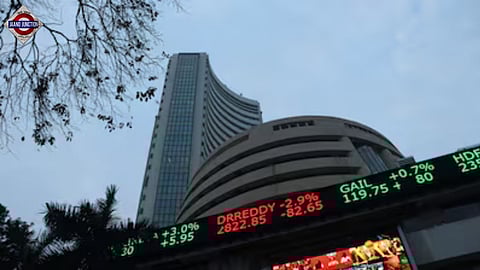

A day after a market crash following the Budget’s provision to hike Securities Transaction Tax (STT), the domestic equity market saw a positive start on Monday. The BSE Sensex jumped by 350 points to 81,112.03 in the opening trade, while the NSE Nifty rose 91 points to trade above the 24,900 level at 24,910.85. However, the early session remains volatile.
Among the 30 Sensex shares, 18 stocks were trading in the green. Among the top gainers were Adani Ports, Larsen & Toubro, BEL, IndiGo and PowerGrid rising by up to 2.35%. The top laggards were Infosys, Trent, Titan, ITC, and Hindustan Unilever, falling by up to 1.46%.
The advance-decline ratio remained in favour of declines. Out of 3,317 shares being traded on the BSE, 1,427 stocks gained, whereas 1,286 shares declined.
A total of 35 stocks hit their 52-week highs, while 119 shares fell to touch their 52-week lows.
Aakash Shah, technical research analyst at Choice Equity Broking Private Ltd, said, “Near-term sentiment remains cautious despite some support from domestic technical indicators. The broader market direction will largely be influenced by global equity cues, crude oil price movements, and institutional fund flows."
On Sunday, the Nifty saw an aggressive sell-off after the Budget 2026 announcement to hike STT, plunging nearly 870 points from 25,440 to an intraday low of 24,571, before staging a partial recovery to close at 24,825.
“A strong bearish candle was formed, with the index closing decisively below the 200-day EMA, indicating a deterioration in trend strength. Immediate resistance is placed at 24,950–25,000, while key support lies in the 24,650–24,700 zone. The RSI slipped to 31, reflecting oversold conditions, while India VIX surged 10.73% to 15.09, highlighting elevated market volatility," Shah said.
On Sunday, February 1, foreign institutional investors (FIIs) sold equities worth Rs 588 crore, while domestic institutional investors (DIIs) also remained net sellers, offloading shares worth Rs 682 crore, adding to the pressure on the market.
V K Vijayakumar, chief investment strategist at Geojit Investments Ltd, said, “Yesterday’s market selloff resulting in 495 point crash in Nifty was a knee-jerk reaction to the sharp increase in STT on F&O trades. This was not a revenue-raising measure, but a decision to discourage retail traders from complex F&O trading, in which 92% of them were losing money. This decision is in the interest of retail investors. But this decision impacted the market sentiments, which were already impacted by the decision to make no changes in the LTCGs tax, which a section of the market was expecting rather unrealistically."
It is important to understand that the Budget is a growth-oriented Budget with fiscal prudence. The 10% nominal GDP growth projected in the Budget is achievable and has the potential to deliver around 15% earnings growth in FY27. The market will soon start discounting this positive. But it is possible that FIIs may continue to sell impacting the market. Retail investors should keep their cool and remain invested and continue to invest systematically. A significant upturn in the market may take time; perhaps a retreat from AI trade globally. We don’t know when this will happen. But we know that an earnings rebound is imminent in response to this growth oriented Budget. That is a clear positive, he added.

