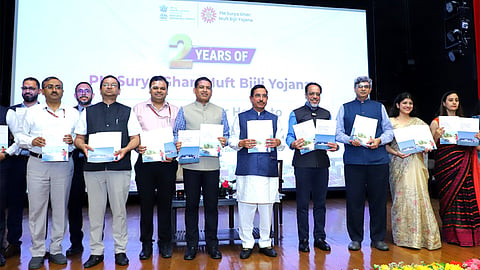

New Delhi: When Prime Minister Narendra Modi launched the PM Surya Ghar: Muft Bijli Yojana in February 2024, the vision was ambitious: enable one crore Indian households to install rooftop solar systems, reduce their electricity bills and transform them from mere consumers of power into producers of clean energy. Two years later, the scheme has crossed the milestone of 40 lakh beneficiary households, and the government's focus has now shifted towards the next challenge bringing the remaining 60 lakh households on board before the March 2027 deadline.
To accelerate this journey, the Centre is considering a WhatsApp-based chatbot that would allow citizens to instantly check rooftop solar installation costs, subsidy eligibility, estimated savings and empanelled vendors. The move signals the government's intention to use digital tools to bridge awareness gaps and simplify access to one of India's most ambitious clean-energy programmes.
The proposed chatbot may appear like a small technological intervention, but it reflects a much larger strategy. As the PM Surya Ghar scheme enters its final stretch towards the one-crore target, policymakers are increasingly focusing on making information, financing and vendor access easier for ordinary households.
A Scheme That Aims to Redefine Household Energy Consumption
The PM Surya Ghar: Muft Bijli Yojana was launched on February 29, 2024, under the Ministry of New and Renewable Energy (MNRE) with a total outlay of ₹75,021 crore. Of this, ₹65,700 crore has been earmarked as Central Financial Assistance to support rooftop solar installations across the country.
At its core, the scheme seeks to enable one crore households to install rooftop solar systems and receive up to 300 units of free electricity every month. However, the programme goes beyond subsidised electricity. It aims to create a decentralised energy model where households generate their own power and, in many cases, earn income by supplying surplus electricity back to the grid.
This concept marks a significant departure from India's traditional electricity model. Instead of relying solely on large power plants and centralised generation systems, rooftop solar places energy production directly in the hands of citizens.
Government documents describe this transition as moving households from being "consumers" to becoming "prosumers"—both producers and consumers of electricity.
The Numbers Behind the Mission
As of May 2026, more than 40.91 lakh households have been covered under the PM Surya Ghar scheme. While the figure represents substantial progress, it also highlights the scale of the challenge ahead. To meet the March 2027 target, India will need to add nearly 60 lakh more rooftop solar households within the remaining implementation period.
The government remains optimistic.
Officials view this achievement as evidence that rooftop solar adoption is gradually evolving into a mass movement rather than remaining a niche energy initiative.
Why the WhatsApp Chatbot Matters

For many households, the biggest obstacle to installing rooftop solar is not cost alone—it is uncertainty.
Questions such as "How much will the system cost?", "How much subsidy am I eligible for?", "Which vendor should I choose?" and "How much money can I save?" often discourage potential applicants.
According to reports, users would be required to enter basic information, including their sanctioned electricity load and recent electricity bill amount. Based on these details, the chatbot would generate personalised estimates regarding:
Consumers would also be able to request callbacks for further assistance. To improve accessibility, QR codes linked directly to the chatbot may be integrated into awareness campaigns and promotional materials.
Under the current framework:
Households installing systems up to 2 kW are eligible for support amounting to 60 percent of benchmark costs.
- Additional capacity up to 3 kW receives support of 40 percent of benchmark costs.
- The maximum subsidy available under the scheme is ₹78,000.
For a typical household, this translates into significant reductions in upfront costs.
A 1 kW system attracts a subsidy of ₹30,000, while a 2 kW system can receive ₹60,000. Systems of 3 kW or above are eligible for the maximum subsidy of ₹78,000.
Importantly, the subsidy is transferred directly into the beneficiary's bank account through Direct Benefit Transfer (DBT), reducing the scope for intermediaries and delays.
What Does It Mean for Households?
Government estimates suggest that households can save between ₹15,000 and ₹18,000 annually on electricity bills after installing rooftop solar systems.
For families facing rising household expenses, these savings can significantly improve monthly budgets.
If a household generates more electricity than it consumes, the surplus can be exported to the grid through net metering arrangements. Distribution companies purchase this excess power, creating an additional source of income for consumers.
States Driving India's Rooftop Solar Revolution
Gujarat currently leads the nation with more than 6.81 lakh cumulative rooftop solar installations. Maharashtra follows closely with over 6.05 lakh installations, while Uttar Pradesh has crossed 5.64 lakh installations.
During the "Month of Solar" campaign, Uttar Pradesh emerged as a standout performer, leading in consumer applications, solar installations and vendor registrations.
Gujarat dominated several performance categories, while Maharashtra demonstrated strong growth in inspections and implementation.
Other states, including Rajasthan, Kerala, Odisha, Haryana, Assam and Uttarakhand, also registered notable gains, indicating that rooftop solar adoption is expanding beyond traditional leaders.
The broad geographic spread suggests that rooftop solar is no longer confined to a handful of states but is increasingly becoming a nationwide phenomenon.
Energy Security: The Bigger Strategic Goal
India remains one of the world's largest importers of fossil fuels, making the economy vulnerable to global energy price shocks and geopolitical disruptions.
By expanding rooftop solar generation, policymakers hope to reduce dependence on imported energy and strengthen domestic energy resilience.
Officials argue that millions of small rooftop solar systems collectively create a more secure and decentralised energy network than dependence on a limited number of large generation centres.
This approach also reduces transmission losses and eases pressure on the national electricity grid.
Climate Commitments and Global Leadership
The government estimates that PM Surya Ghar could contribute around 1,000 billion units of clean electricity generation over the lifetime of installed systems.
At a time when many countries continue to struggle with balancing economic growth and environmental commitments, Indian policymakers view rooftop solar as a practical solution that addresses both challenges simultaneously.
The Employment Opportunity
Government estimates suggest that the programme could generate around 17 lakh direct and indirect jobs across manufacturing, logistics, installation, operations and maintenance.
Officials believe these technicians could emerge as micro-entrepreneurs, helping create a self-sustaining rooftop solar ecosystem that supports local employment while accelerating adoption.
The Road to March 2027
Reaching the one-crore mark will require sustained momentum, faster installations, stronger awareness campaigns and seamless coordination between governments, distribution companies and vendors.
The proposed WhatsApp chatbot represents one piece of that larger puzzle. By simplifying access to information and helping consumers understand costs, subsidies and benefits, the government hopes to convert curiosity into adoption.
Whether India ultimately reaches the one-crore target by March 2027 remains to be seen. What is clear, however, is that PM Surya Ghar is no longer merely a subsidy programme. It has evolved into a nationwide mission that combines energy security, household savings, job creation, climate action and digital governance.
And as India moves from 40 lakh to one crore solar-powered homes, the success of that mission could reshape how the country generates, consumes and thinks about energy for decades to come.
