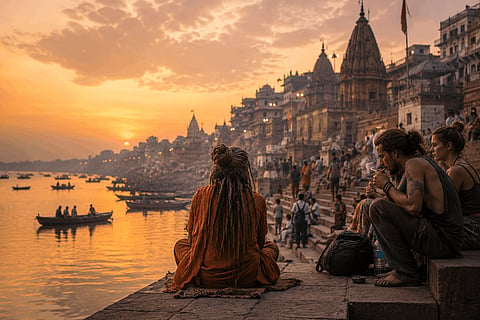

Varanasi has always been a city that defies ordinary description.
To some, it is Kashi, the City of Light. To others, it is the eternal abode of Lord Shiva. For millions of Hindus, it is the holiest city on Earth, where the sacred Ganga carries prayers, ashes, hopes, and memories toward eternity. For philosophers, it is a living classroom. For seekers, it is a destination. For believers, it is a homecoming.
For thousands of years, people have arrived in Kashi not to escape reality but to confront it. They came seeking answers to questions of life, death, suffering, liberation, and the human condition itself.
Today, however, an uncomfortable question is emerging among many residents of the city:
Is Varanasi slowly becoming known for something entirely different?
The concern is not about tourism. Tourism has always been part of Varanasi's identity. Pilgrims, scholars, travelers, monks, artists, and foreigners have walked its lanes for centuries.
The concern is about a specific type of tourism.
A growing number of residents believe that sections of the city are increasingly attracting visitors who view Varanasi not primarily as a spiritual destination but as a place where intoxicants are easily available and socially tolerated.
Whether this perception is entirely accurate or only partially true, the perception itself deserves attention because perceptions eventually shape realities.
The question before us is not whether Varanasi should welcome visitors.
The question is whether Varanasi can continue welcoming the world without losing its soul.
The Success Story Nobody Can Deny
By most measurable indicators, modern Varanasi is a remarkable success story.
Over the past decade, the city has undergone significant transformation.
Roads have improved.
Connectivity has expanded.
The Kashi Vishwanath Corridor has altered the urban landscape.
The ghats have been renovated.
Cruise tourism has increased.
Airport connectivity has expanded.
Hotels, guest houses, restaurants, and tourism-related businesses have flourished.
Tourism numbers have reached unprecedented levels.
What was once largely a pilgrimage destination has become a globally recognized cultural and spiritual tourism center.
For local businesses, this growth has created opportunities.
Boatmen have more customers.
Hotels have higher occupancy.
Restaurants serve more guests.
Taxi operators receive more bookings.
Artisans find larger markets.
Employment opportunities have expanded.
No reasonable person can deny these benefits.
Tourism has become an important economic engine for Varanasi.
Yet history repeatedly demonstrates that rapid tourism growth often brings unintended consequences.
The challenge is not attracting visitors.
The challenge is managing the cultural effects of success.
A Different Kind of Visitor
Traditionally, the majority of visitors arriving in Kashi came for one of four reasons:
Religious pilgrimage.
Spiritual exploration.
Cultural curiosity.
Academic interest.
Many still do.
However, conversations with residents, priests, shopkeepers, guides, and boat operators increasingly reveal another phenomenon.
Certain visitors arrive not because they are interested in Shiva, Sanskrit, philosophy, meditation, or Hindu civilization.
They arrive because they have heard stories about bhang, cannabis culture, and easy access to intoxicants.
This distinction matters.
A spiritual tourist generally contributes to the preservation of a city's culture.
A drug tourist often consumes the culture without respecting it.
One seeks meaning.
The other seeks stimulation.
The difference may appear subtle at first.
Eventually it becomes visible in behavior.
The Normalization of Intoxication
Walk through certain areas frequently visited by backpackers and foreign tourists.
Spend enough time around selected stretches of the ghats.
Observe online travel discussions.
Listen to conversations among some younger visitors.
A pattern becomes visible.
Intoxication is increasingly being marketed as part of the "Varanasi experience."
This is where concern begins.
Because cities eventually become what they are repeatedly advertised to be.
If Varanasi is promoted as a center of spirituality, it attracts seekers.
If it is promoted as a center of intoxication, it attracts consumers.
The city cannot indefinitely sustain both identities without conflict.
The Misrepresentation of Lord Shiva
Perhaps the most troubling aspect of this trend is the way Lord Shiva is frequently invoked as justification.
The argument is familiar.
"Mahadev used bhang."
"It is Shiva's prasad."
"Getting high is part of Shaivism."
These statements are repeated so often that many people have stopped questioning them.
Yet they collapse under serious examination.
The image of Shiva in Hindu philosophy is not the image of a pleasure-seeking intoxicated wanderer.
Shiva represents supreme consciousness.
He represents meditation.
He represents discipline.
He represents transcendence over desire.
He represents mastery over the mind.
In countless depictions, Shiva sits in deep meditation, demonstrating control over the senses rather than surrender to them.
To use Shiva's image as a justification for recreational intoxication is a profound misunderstanding.
The symbolism of Shiva cannot be reduced to a smoking accessory printed on a T-shirt or a poster in a tourist café.
If one wishes to imitate Shiva, one must imitate his discipline, austerity, compassion, and detachment.
Modern drug culture rarely advocates any of these virtues.
The Cultural Cost
Economic benefits are easy to calculate.
Cultural losses are not.
A city can earn more money while losing part of its identity.
A city can become famous while becoming less authentic.
A city can attract millions of visitors while slowly alienating the very traditions that made it attractive in the first place.
This process has occurred across the world.
Historic neighborhoods become entertainment districts.
Sacred spaces become photo opportunities.
Traditional communities become tourist spectacles.
Authenticity is replaced by performance.
What makes Varanasi unique is that its value lies almost entirely in its authenticity.
People do not travel to Kashi because it is modern.
They travel to Kashi because it is ancient.
They do not come because it resembles every other tourist city.
They come because it resembles no other city on Earth.
Therefore, protecting authenticity is not merely a cultural responsibility.
It is also an economic necessity.
Impact on Local Youth
Perhaps the most important aspect of this discussion receives the least attention.
What happens when local youth observe the normalization of intoxication?
Tourists leave.
Residents stay.
The long-term consequences are borne by the local population.
When young people repeatedly see drug use portrayed as fashionable, spiritual, artistic, rebellious, or sophisticated, social resistance weakens.
Behavior that once seemed unacceptable begins to appear normal.
Normalization precedes adoption.
Adoption precedes addiction.
Addiction precedes tragedy.
Families suffer.
Educational performance declines.
Crime increases.
Health deteriorates.
Communities weaken.
These patterns are visible across societies throughout history.
Varanasi is not immune.
Law Enforcement Challenges
The responsibility placed upon police and enforcement agencies is considerable.
Varanasi receives millions of visitors annually.
Monitoring every lane, ghat, café, guest house, and gathering point is practically impossible.
Yet enforcement remains essential.
A clear distinction must be maintained between religious traditions that operate within the law and criminal networks that exploit those traditions as cover.
Drug trafficking is not spirituality.
Illegal narcotics distribution is not culture.
Organized supply chains are not devotion.
Authorities therefore face a difficult balancing act.
They must preserve religious freedom while preventing criminal exploitation.
They must welcome tourism while protecting public order.
They must encourage openness without encouraging lawlessness.
Lessons from Goa
Many residents invoke Goa when discussing these concerns.
The comparison is not perfect.
Goa and Varanasi are fundamentally different places.
One is a coastal leisure destination.
The other is a sacred spiritual city.
Yet the comparison remains useful because it illustrates how tourism can alter identity over time.
Goa's tourism industry generated prosperity.
It also generated debates regarding commercialization, narcotics, cultural dilution, environmental stress, and changing community dynamics.
Many Goans today continue discussing how to balance economic growth with cultural preservation.
Varanasi has the opportunity to learn from these experiences before similar problems become deeply entrenched.
The Responsibility of Society
Government action alone cannot solve this issue.
Communities must participate.
Religious institutions must participate.
Educational institutions must participate.
Tourism businesses must participate.
Content creators must participate.
Local citizens must participate.
Every time someone presents Varanasi merely as a place to get intoxicated, they contribute to a false narrative.
Every time someone highlights its philosophy, music, scholarship, spirituality, architecture, rituals, literature, and traditions, they strengthen the authentic narrative.
The battle for a city's identity is ultimately a battle of stories.
The story most frequently told becomes the story most widely believed.
Reclaiming the Narrative
Varanasi possesses resources that no marketing campaign can manufacture.
It possesses history.
It possesses continuity.
It possesses sacred geography.
It possesses intellectual traditions.
It possesses spiritual authority.
Very few cities in human civilization can claim even one of these attributes.
Varanasi possesses all of them.
The challenge is ensuring that future generations inherit the same city that previous generations preserved.
This does not mean resisting change.
Every living city changes.
The question is whether change serves the city's identity or undermines it.
Modernization should strengthen Kashi.
Tourism should strengthen Kashi.
Development should strengthen Kashi.
None of them should replace Kashi.
A City Worth Protecting
The concern expressed in this article is not anger toward tourists.
Nor is it hostility toward outsiders.
It is concern for a civilization asset that belongs not only to Uttar Pradesh or India but to humanity.
Varanasi has survived invasions, political upheavals, social transformations, and centuries of change.
Its greatest strength has always been its ability to remain itself.
Today, the threat is not military.
It is cultural.
The danger is not sudden destruction.
It is gradual dilution.
The question facing Kashi is simple:
Will it remain a city known primarily for awakening consciousness, or will it become known for escaping it?
The answer depends on choices being made right now by citizens, businesses, religious leaders, tourists, and governments alike.
Because once a city's reputation changes, rebuilding it can take decades.
And some things, once lost, cannot easily be recovered.
Kashi is more than a destination.
It is an inheritance.
And inheritances are not merely enjoyed.
They are protected.
Views expressed in Citizen Junction stories are that of the author and solely of the author, submitted to Jaano Junction through WRITE. Start writing on Jaano Junction to get your opinion published. Click Here to start your citizen journalism journey.
